
I spent 30 years living in Ukraine. A book I recently finished has brought some of those years, and the history behind them, into sharper focus.
We moved to Ukraine in 1992, just after the collapse of the Soviet Union, to help plant churches.
I remember how Soviet everything still felt. To establish a church officially, we had to deal with the government’s Religious Affairs Department. There was a sense that the authorities were watching, that even religious activity needed government approval.
I remember returning to Ukraine after visiting family in America and almost feeling the weight of oppression as we arrived. People were cautious about speaking their minds. There was fear, and sometimes good reason for it.
But over the years, I watched something change.
People became less afraid to speak up. Religious freedom expanded. Ukrainians increasingly challenged those in power. The country was finding its voice, and in many ways rediscovering an identity that had long been suppressed.
It wasn’t simple. Ukraine was, and remains, incredibly diverse. People had different understandings of their history, their relationship with Russia, and what their country’s future should look like. Corruption and the legacy of Soviet institutions were real obstacles.
And freedom came at a cost.
During the Revolution of Dignity in 2013–2014, more than 100 people lost their lives. Ukrainians were willing to risk everything for the right to determine their own future.
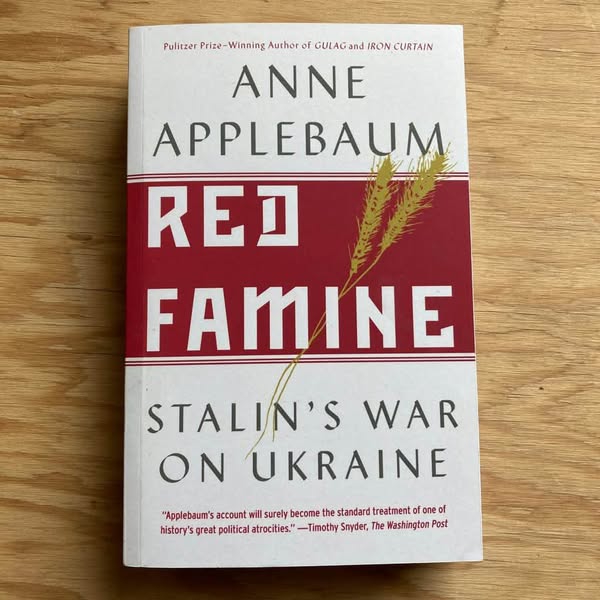
Recently, I finished Red Famine by Anne Applebaum, a deeply disturbing account of the Holodomor, the man-made famine under Stalin that killed millions of Ukrainians in 1932–33.
I knew much of this history, but the book brought certain patterns into sharper focus.
For centuries, Ukrainian identity and aspirations for self-determination have repeatedly collided with rulers in Moscow who sought to control Ukraine.
Under the Russian Empire, Ukrainian language and culture faced suppression. Under Stalin, famine and political repression devastated Ukrainian society. And today, under Putin, Russia is once again using military force to try to bring Ukraine under its control.
Different regimes, different ideologies, different circumstances. Yet some troubling parallels.
One thought from the book has stayed with me especially:
What if Ukraine’s determination to be free is itself part of what makes it so threatening to Russia’s rulers?
A neighboring country where people challenge their leaders, demand accountability, and insist on choosing their own future presents a very different picture from the authoritarian system Putin has built.
Of course, this war has many causes and dimensions. Geopolitics, security, economic interests, history, and political power all play a role. I don’t want to reduce something so complicated to one explanation.
But there’s another part of Red Famine that got me thinking.
The Soviet government worked to conceal the famine. Some Western journalists who knew what was happening minimized or denied it. Others who tried to tell the truth were discredited. Western governments had information about the suffering but often prioritized their political interests.
Millions died, and for decades much of the truth remained buried.
That has made me reflect on something personal.
Sometimes I hesitate to share another story about Ukraine. Another bombing. Another family suffering. Another reminder of a war that many people are tired of hearing about.
I wonder if I’m bothering people. If it’s becoming too much.
But reading this history reminded me why speaking up is important.
Silence can be comfortable, especially when suffering is far away or when acknowledging it complicates our political views.
I don’t pretend to have all the answers. I’m still learning, and I want to keep listening, especially to Ukrainians whose experiences and perspectives differ from my own.
But I don’t want to become silent simply because the truth is uncomfortable.
People who are suffering deserve more than our silence. And people fighting for survival deserve our support.
Our children grew up in Ukraine. Since Russia’s full-scale invasion in 2022, we have been living in Budapest, Hungary, but our hearts remain in our adopted homeland. People we love are still living through this war, and I will continue to tell their stories for as long as it takes.
Recommended Reading
Red Famine: Stalin’s War on Ukraine by Anne Applebaum. A deeply disturbing account of the Holodomor, the man-made famine under Stalin that killed millions of Ukrainians in 1932–33. Find the book at Penguin Random House.
Support more stories of hope
Your gift directly funds the missionaries, programs, and communities that make this ministry possible across Europe.
Support the Work